Welcome to WorldFoundry
WorldFoundry
Unified World Model Inference & Evaluation Infrastructure
Discover
Model & benchmark
Prepare
Runtime & assets
Run
Unified generation
Inspect
Durable artifacts
Evaluate
Reviewable evidence
One workflow
- Discovery, inference, inspection, and evaluation in one reproducible path
- TUI, CLI, Studio, Python, and MCP share the same request and artifact contracts
- Inspect manifests, needs, and blockers before allocating GPUs or downloading weights
- Durable artifacts support later review, rescoring, and evidence reuse
- Python API reference generated from live source signatures and docstrings
Breadth with clear boundaries
- 240+ cataloged models and benchmarks with explicit readiness signals
- Native upstream runtimes across video, 3D/4D, interactive worlds, and embodied stacks
- Benchmarks score outputs without taking ownership of model loading
- Generation and scoring can run in separate environments when required
- Scorecards capture provenance, coverage, blockers, and what each result can support
- CLI stays the source of truth for integration state and next actions
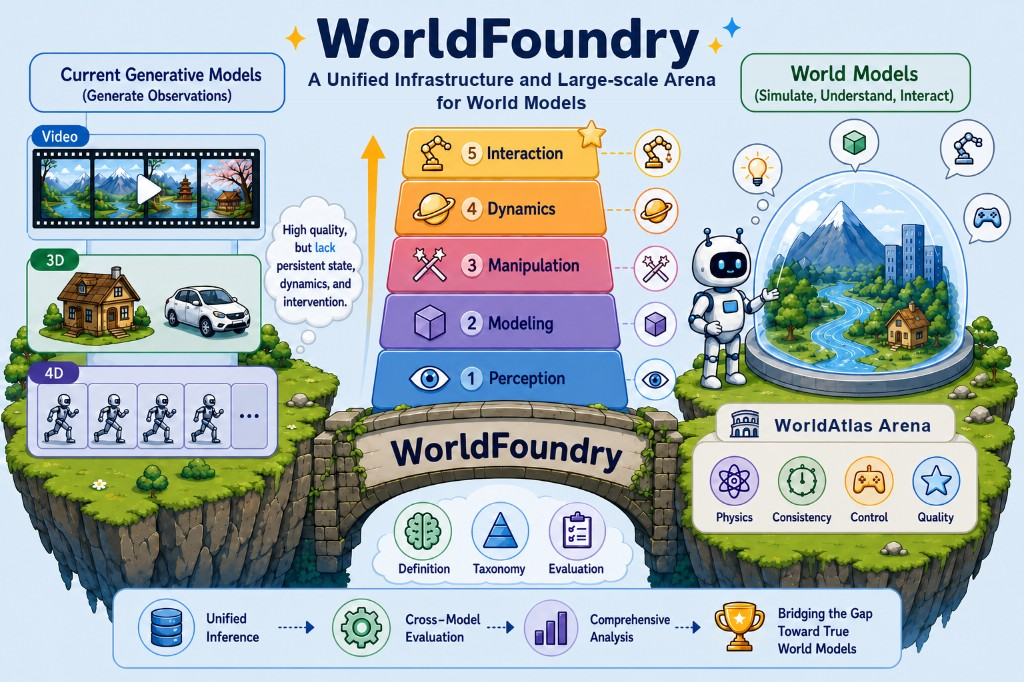
WorldFoundry is open-source infrastructure for running and evaluating world models. It does not propose one new model architecture. It brings model discovery, runtime preparation, inference, artifact inspection, benchmark execution, and evidence reporting into one workflow across video, 3D/4D, interactive-world, and embodied systems:
Discover a model, prepare its runtime and assets, generate inspectable artifacts, evaluate those artifacts, and preserve the result as reviewable evidence.
That distinction matters. A model catalog is not the same thing as a working runtime. A convincing demo is not the same thing as benchmark evidence. A successfully imported score is not automatically leaderboard parity. WorldFoundry keeps those states separate and visible.
It is built for a practical research problem: every upstream project can produce something useful, but each uses different environments, checkpoints, inputs, launch commands, output layouts, and evaluation protocols. WorldFoundry preserves those native differences while standardizing the boundaries around them.
The problem it solves
World-model projects usually arrive as independent repositories. Each one makes different choices for environments, checkpoints, input schemas, launch scripts, output layouts, preview tools, and evaluation code. A team that wants to compare several systems ends up rebuilding the same integration layer for every model.
The fragmentation begins with discovery. The same model may be referred to by a paper name, a repository name, a checkpoint name, or a local folder. WorldFoundry gives models and benchmarks stable IDs and declarative manifests so the source, intended capability, runtime binding, required assets, and known blockers can be inspected before anything expensive runs.
It continues through execution. Instead of placing checkpoints and datasets wherever an upstream script happens to expect them, WorldFoundry defines reusable local asset roots and model-specific runtime profiles. Pipelines and operators keep native model differences explicit while presenting a consistent request, result, and artifact boundary to the rest of the system.
Finally, it affects evaluation. Videos, meshes, actions, and traces should not disappear into custom folders or one-off notebooks. WorldFoundry preserves what was requested, what ran, what was produced, how it was scored, which samples were covered, and which conditions still block an official claim.
The goal is not to hide every model difference behind one tiny API. The goal is to keep those differences in the correct layer while making the end-to-end research workflow consistent.
How the project works
Discover
Choose a model and benchmark
Catalog manifests expose stable IDs, capabilities, readiness, assets, and blockers.
Prepare
Stage runtime and assets
Resolve the conda profile, checkpoints, datasets, metric weights, and credentials.
Run
Generate through one contract
TUI, CLI, scripts, and Studio dispatch to a pipeline and operator.
Inspect
Review normalized artifacts
Videos, geometry, actions, traces, and metadata remain visible and reusable.
Evaluate
Produce reviewable evidence
Metrics and official runners write reports, blockers, and a normalized scorecard.
The central boundary is the artifact. A model runner turns a normalized request into a result containing videos, geometry, action traces, or other outputs. A benchmark runner consumes those outputs and produces metrics and evidence. This separation lets one model output be inspected, reused, or scored by more than one compatible benchmark without coupling the model implementation to evaluator internals.
Catalogs form the control plane around that boundary. They describe what exists, where it came from, what it needs, how it can be dispatched, and what evidence supports its current readiness. TUI, CLI, Studio, Python, and MCP are different ways to operate the same underlying system rather than separate implementations.
A concrete run: Matrix-Game 2
For a first matrix-game-2 run, let catalog and local-asset checks answer which model is selected and whether its checkpoint is ready, then generate one small result:
bash scripts/inference/prepare_model_infer.sh matrix-game-2 --download
python -m worldfoundry.evaluation zoo model-download \
  --model-id matrix-game-2 --check-local --json

bash scripts/inference/test_nav_video_gen.sh matrix-game-2 \
  --output-dir tmp/matrix_game2_first_run
The last command runs the model with action-conditioned input and writes the video plus its run records to the selected directory. At this point the justified claim is that this configuration produced an inspectable artifact. The motion and continuity can be reviewed in Studio or a local player, and compatible metrics can consume the artifact. One video alone does not establish that a complete benchmark ran. This is why WorldFoundry separates generation, inspection, scoring, and eligibility.
Read Design for the layers, contracts, and rationale behind this workflow.
Acknowledgements
WorldFoundry integrates and adapts upstream world-model, video-generation, perception, reconstruction, embodied-action, and evaluation projects. Each catalog entry keeps its own source and license metadata.
Infrastructure foundations
- FastVideoUnified inference and post-training framework for accelerated video generation.
- OpenWorldLibUnified codebase for advanced world models.
- VLA Evaluation HarnessFramework for evaluating VLA models on robot simulation benchmarks.