Studio
Launch and operate the multi-frontend Studio for pipeline preview, streaming, and interactive world-model debugging.
On this page
Introduction
WorldFoundry Studio is a thin visual entrypoint around repo pipelines. The model is fixed at launch time; use a new process for a different model family.
Studio exposes multiple frontends:
| Frontend | Best for | Notes |
|---|---|---|
world | Interactive world models | Standalone WebRTC console with a resident model runtime, reliable input-edge DataChannel, bounded in-memory frame queue, one persistent video track, immersive fullscreen, and a live runtime log. It does not render through Gradio or materialize an MP4 per control step. |
points | Viser point clouds / meshes | Starts native Viser directly instead of embedding it in the console shell. |
embodied | Embodied simulators | Planned. URL bridge only: Studio registers an external simulator URL and tunnel hints; no in-tree embodied viewer yet. |
spark | 3DGS | Starts the standalone Spark 3DGS viewer with repository-local Spark assets. |
auto | Default | Routes interactive worlds to world, 3D scenes to spark, point/depth workflows to points, and embodied policies to embodied. |
What it shows
| Surface | Purpose |
|---|---|
| Preview Video | Latest generated or streamed video. |
| Preview Image | Still-image outputs and imported reference frames. |
| 3D World | Gaussian splat, point cloud, or spatial outputs when exported. |
| Gallery | Recent shots and preview artifacts. |
| Artifacts | Raw output artifacts for inspection and download. |
By default, Studio hides most advanced panels. Use --show-aux-panels for history, notes, catalog, 3DGS import, and low-level runtime controls.
Workspace Mode
For multi-model validation and release QA, run the workspace app instead of a single-model Studio process:
source tmp/worldfoundry_unified_env.sh
conda activate "${WORLDFOUNDRY_UNIFIED_ENV_PREFIX}"
bash scripts/workspace/run_workspace.sh \
--host 127.0.0.1 \
--port 7870 \
--max-jobs 8Use explicit roots when your checkpoints or benchmark data live outside the default cache:
bash scripts/workspace/run_workspace.sh \
  --ckpt-dir /path/to/checkpoints \
  --data-dir /path/to/benchmark-data
The launcher is open-source friendly and does not depend on machine-specific
paths. It resolves assets in this order: command-line option, already exported
environment variable, repo-sibling ckpt/ or data/ directory when present,
env-file value from tmp/worldfoundry_unified_env.sh, then
~/.cache/worldfoundry/....
Start the Workspace from the unified model runtime environment, not from a
lightweight UI-only environment. For CUDA 12.8 hosts this is usually
worldfoundry-unified-cu128 after source tmp/worldfoundry_unified_env.sh. If
LOAD or START fails with a missing import such as cv2, restart 7870
from that unified environment before debugging model code.
Do not copy or relocate a prepared conda environment between machines. Native
Python and OpenSSL links can point back to the original prefix, which makes
resident inference workers fail even when the browser server starts. If the
Workspace reports a missing python3.x, missing cv2, or libssl/libcrypto
error, recreate or verify the unified env through the public setup command:
bash scripts/setup/bootstrap_worldfoundry.sh --verify-only
source tmp/worldfoundry_unified_env.sh
bash scripts/workspace/run_workspace.sh
Open:
http://127.0.0.1:7870/The workspace is the preferred UI for release validation. Use it to submit inference jobs, inspect model-specific forms, review artifacts, and compare runs without switching between multiple one-off scripts.
Workspace also supports evaluation jobs. For VBench, select Evaluation,
choose benchmark vbench, put generated videos in Dataset Root (or an
official VBench results JSON in Results Path), and set Metrics to one or
more dimensions such as aesthetic_quality, motion_smoothness, or the preset
custom_supported. VBench-specific runtime options such as
{"mode":"custom_input","load_ckpt_from_local":true} go in Eval Runtime
JSON.
Create Job configuration
There is no separate Settings page in the Workspace UI. Configure each job in the Create Job dialog before submission.
| Field group | What it controls |
|---|---|
| Model / variant / task profile | Which catalog entry runs and which official input contract is exposed. |
| Prompt, input path, dynamic task fields | Model-specific inputs from the inference contract. |
| Device, backend, attention | Runtime device and loading path (auto, from_pretrained, api_init). |
| Frames, FPS, height, width, steps, guidance, seed | Generation parameters sent in the job payload. |
| Runtime checks | Optional memory/compile toggles such as Torch Compile, CPU Offload, VAE Offload, and Text Encoder Offload. These appear only when the selected model advertises support. |
| Call JSON / Load JSON | Advanced overrides merged into call_kwargs and load_kwargs. |
When you open Create Job or switch task profiles, the form is prefilled from Workspace defaults loaded at startup. Model-specific official demo values from the catalog and task profile still take precedence over those shared defaults.
Default values when no settings file is present:
| Key | Default |
|---|---|
device | cuda, or WORLDFOUNDRY_STUDIO_DEVICE when set |
backend | auto |
attention_backend | auto |
fps | 16 |
num_frames | 81 |
height × width | 720 × 1280 |
num_inference_steps | 30 |
guidance_scale | 7.5 |
seed | -1 |
torch_compile / cpu_offload | false |
Optional persisted defaults
To reuse the same defaults across Workspace restarts, point the server at a JSON settings file:
export WORLDFOUNDRY_STUDIO_SETTINGS_FILE=/path/to/studio-settings.jsonOn startup, the Workspace loads that file into /api/settings. The Create Job
form reads those values through GET /api/settings. Operators can also update
the file programmatically with POST /api/settings:
curl -sS -X POST http://127.0.0.1:7870/api/settings \
  -H 'Content-Type: application/json' \
  -d '{"values":{"fps":12,"num_frames":49,"attention_backend":"torch"}}'
When WORLDFOUNDRY_STUDIO_SETTINGS_FILE is unset, defaults live only in the
running Workspace process and reset on restart.
Fast jobs and preflight checks
Workspace inference defaults to a fast job path. It assumes the selected conda environment, checkpoint roots, and viewer dependencies were prepared before the server was launched. Keep this default for normal repeated inference.
Turn checks on only for setup debugging or release preflight:
| Env var | Default | Effect |
|---|---|---|
WORLDFOUNDRY_STUDIO_RUNTIME_CHECKS=strict | skipped | Validate runtime imports and local model paths before loading a pipeline. |
WORLDFOUNDRY_STUDIO_CHECK_RUNTIME_COMPLETENESS=1 | skipped | Recheck in-tree 3D/4D entrypoints while building the Studio catalog. |
WORLDFOUNDRY_STUDIO_RESIDENT_WORKERS=0 | auto | Disable long-lived conda workers and return to subprocess-per-job dispatch. |
WORLDFOUNDRY_STUDIO_RESIDENT_WORKER_MODELS=matrix-game-2 | all eligible | Limit resident workers to selected model ids; torchrun/multi-GPU jobs still use one-shot subprocesses. |
WORLDFOUNDRY_STUDIO_ARTIFACT_SCAN_MODE=missing | missing | Scan the output directory only when required artifacts are missing from the run record. |
WORLDFOUNDRY_STUDIO_ARTIFACT_SCAN_MODE=always | off by default | Force a full recursive output scan for models that do not return artifact paths. |
WORLDFOUNDRY_STUDIO_ARTIFACT_SCAN_MODE=off | off by default | Never scan the output directory; rely on preview_*, artifact_paths, and rrd_path. |
WORLDFOUNDRY_STUDIO_VALIDATE_PREVIEW_VIDEO=1 | skipped | Decode candidate preview videos before accepting them. |
WORLDFOUNDRY_STUDIO_EXTRACT_VIDEO_PREVIEW_IMAGE=1 | skipped | Extract a still image from generated videos for preview. |
WORLDFOUNDRY_STUDIO_BUILD_RERUN_PREVIEW=1 | skipped | Build .rrd previews automatically for geometry outputs. |
For the fastest finish path, model runtimes should return explicit
preview_image, preview_video, artifact_paths, rrd_path, and output_dir
values in their run record. Use always scanning only as a compatibility mode
for older runtimes that write files without reporting them.
Resident workers keep the conda child process alive across jobs so the child
StudioManager can reuse its pipeline cache. Set
WORLDFOUNDRY_STUDIO_RESIDENT_WORKERS=0 when debugging process startup or when
you need every job to release GPU memory immediately after completion.
Use Visualizers, Gallery, and Artifacts for quick visual QA. They expose recent generated videos, images, manifests, and direct artifact links. Before making release claims, record the verified run in the model inference validation page.
Workspace Visualizers
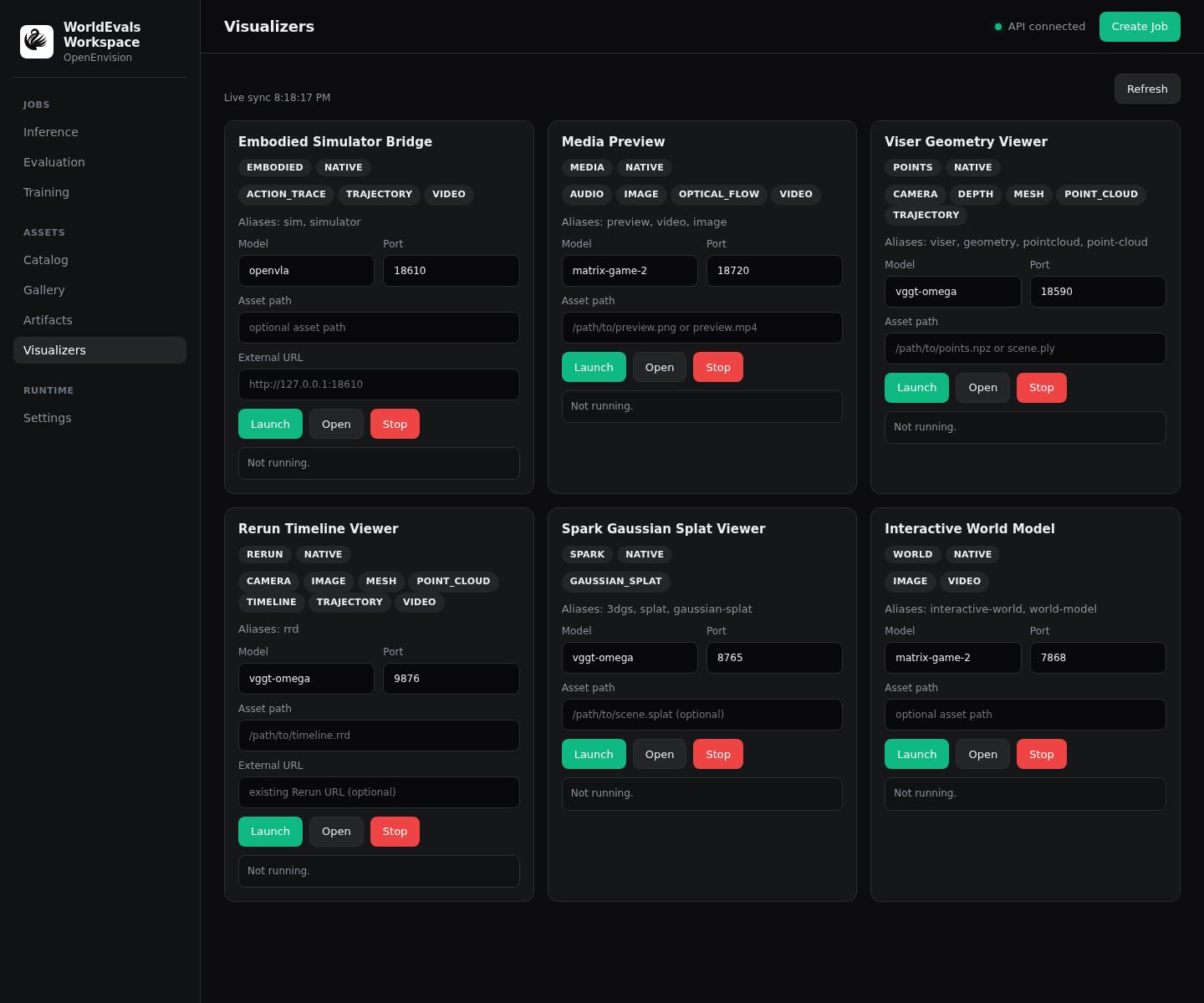
The 7870 Workspace is the browser entrypoint for the visualization stack.
Open the Visualizers tab, then use each card's Launch, Open, and
Stop buttons. The iframe under each card embeds the live viewer, so users
do not need to copy URLs during normal QA. The Embodied Simulator Bridge
card is marked Planned: unlike Viser, Spark, Rerun, and World Rollout, it
does not yet launch an in-tree embodied viewer.
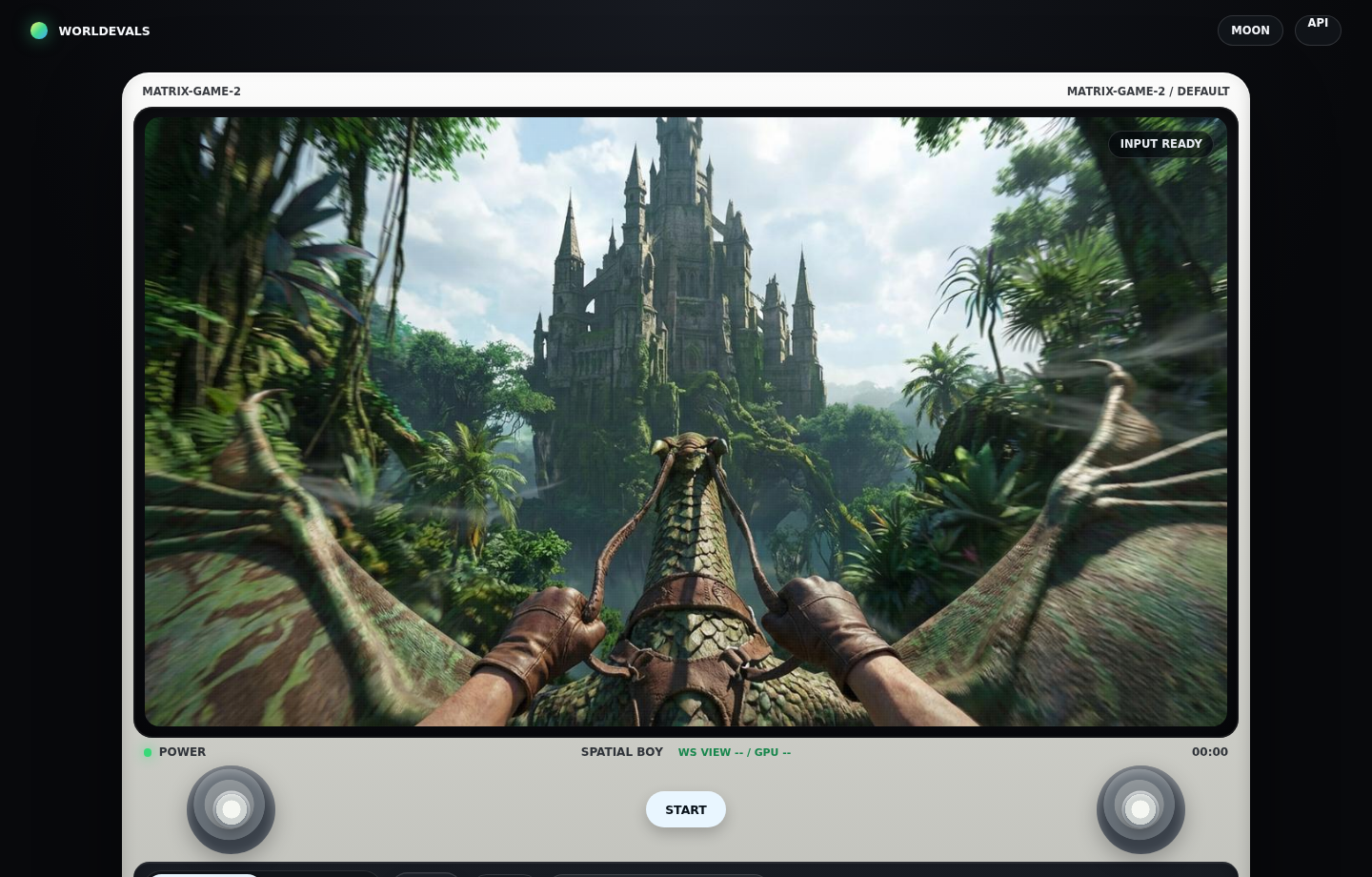
World Rollout Viewer
- Port
7868 - Aliases
interactive-world, world-model, world-rollout
Buffered realtime target for action-conditioned roaming. Controls are sampled continuously while generated chunks are prefetched.
Artifactsimage, video, action_trace
python -m worldfoundry.studio.app matrix-game-2 --frontend world --port 7868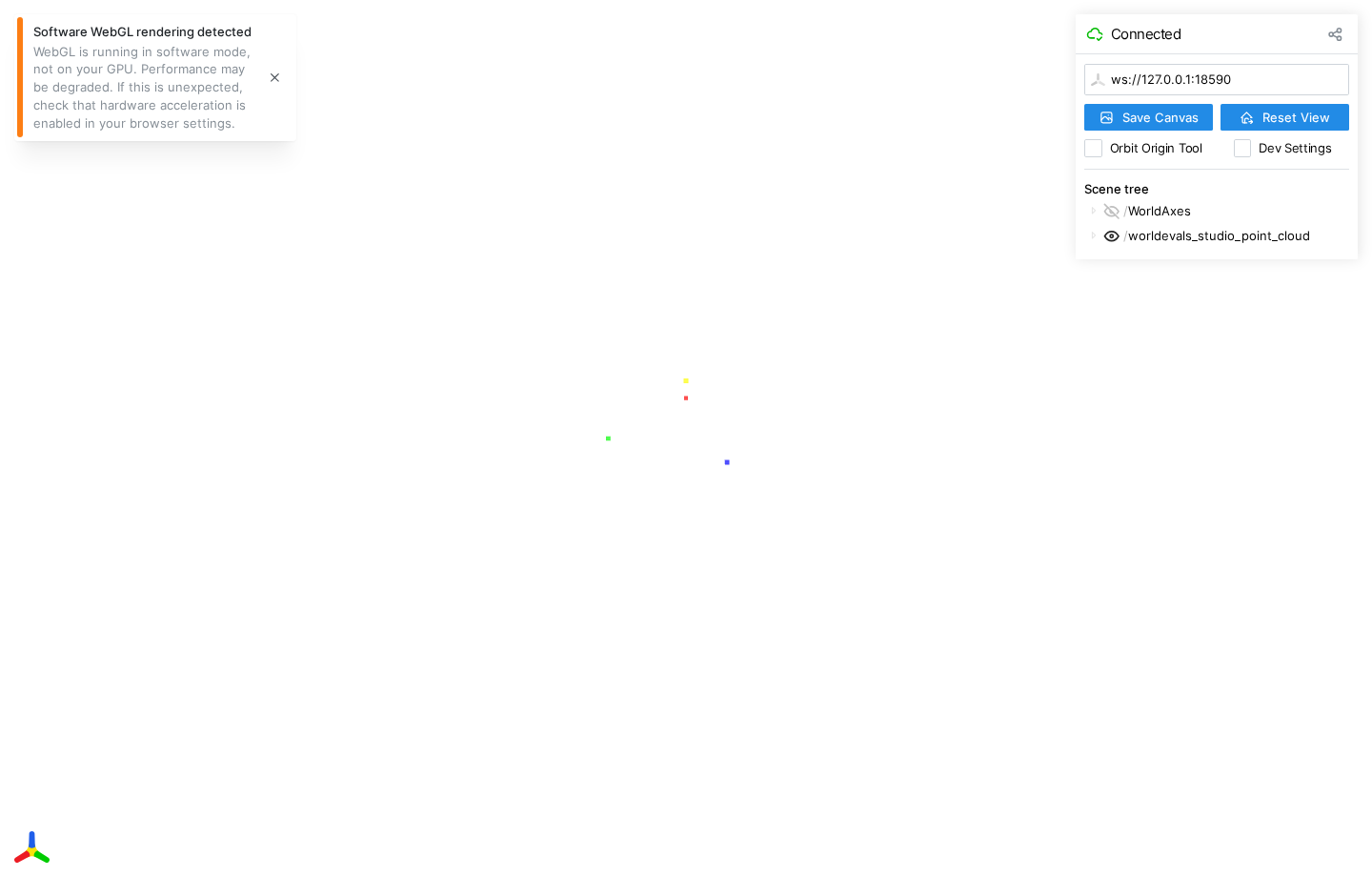
Viser Geometry Viewer
- Port
18590 - Aliases
viser, geometry, pointcloud
Point clouds, depth-derived point sets, meshes, camera poses, and trajectories.
Artifactsply, pcd, xyz, glb, gltf, obj, npz
python -m worldfoundry.studio.app pi3 --frontend points --asset /path/to/scene.ply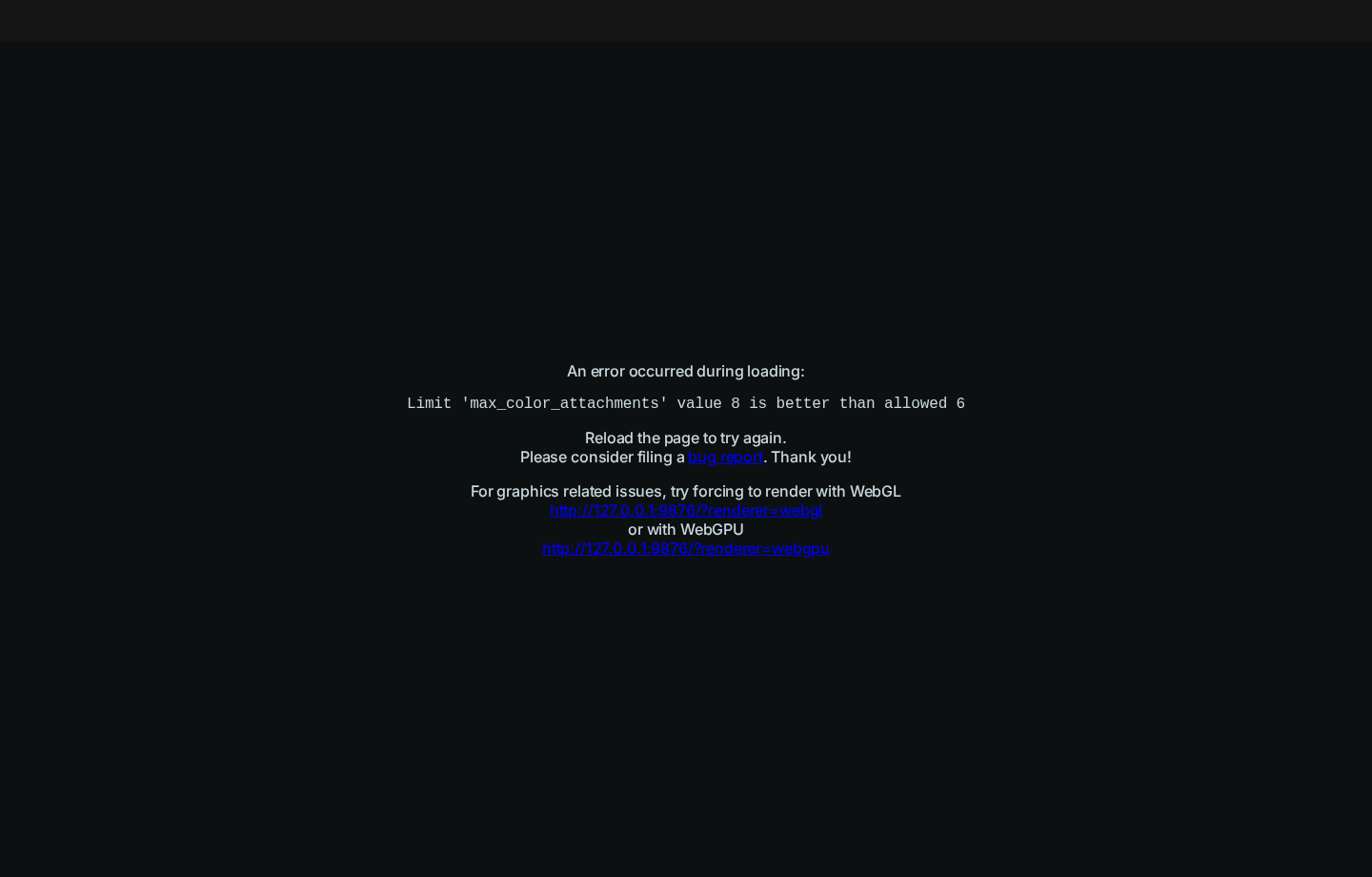
Rerun Timeline Viewer
- Port
9876 - Aliases
rrd
`.rrd` timelines and recordings with synchronized cameras, frames, tracks, and 3D entities.
Artifactsrrd
python -m worldfoundry.studio.app vggt --frontend rerun --asset /path/to/recording.rrdSpark Gaussian Splat Viewer
- Port
8765 - Aliases
3dgs, splat
3D Gaussian splats via the in-tree Spark frontend. Live preview uses the Spark.js Hello World butterfly demo.
Artifactssplat, spz, ksplat, sog, splat-ply
python -m worldfoundry.studio.app vggt --frontend spark --asset /path/to/scene.splat
Embodied Simulator Bridge
Planned- Port
18610 - Aliases
sim, simulator
Planned integration. Studio only registers an external simulator URL and tunnel hints today; there is no in-tree embodied viewer yet. Start the simulator separately, then paste its URL in Visualizers.
Artifactsaction_trace, trajectory, simulator_url
python -m worldfoundry.studio.app openvla --frontend embodied --simulator-url http://127.0.0.1:18610world defaults to port 7868. Set a port manually only when your deployment
requires a fixed proxy route.
The realtime frontend requires worldfoundry[studio_realtime] (also included
by worldfoundry[ui]). Model loading begins in the background when the server
starts. A session then keeps one pipeline context and one execution thread
resident; WASD/IJKL key edges are resampled at chunk boundaries while RGB
frames are delivered over a long-lived WebRTC track. Per-run manifests,
artifact scanning, and MP4 encoding remain Workspace/offline responsibilities
and are intentionally absent from the control-to-frame hot path.
Latency-oriented defaults can be tuned without changing model catalog quality profiles:
| Environment variable | Default | Effect |
|---|---|---|
WORLDFOUNDRY_REALTIME_FPS | 16 | WebRTC video pacing and input-resampler rate. |
WORLDFOUNDRY_REALTIME_CHUNK_FRAMES | 9 | Target frames per generated chunk; known model temporal contracts may override it. |
WORLDFOUNDRY_REALTIME_INFERENCE_STEPS | model default; LingBot Fast 4 | Explicit latency/quality override. Non-distilled models are not silently reduced to four steps. |
WORLDFOUNDRY_REALTIME_FRAME_QUEUE | max(chunk, 8) | One steady-state chunk of bounded playback buffering. |
WORLDFOUNDRY_REALTIME_BACKPRESSURE_MS | half a chunk | Preserve every frame during normal playback; evict stale frames only after this congestion budget expires. |
WORLDFOUNDRY_REALTIME_WARMUP_CHUNKS | 1 | Background stream warmup; set 0 to disable or raise it for compile/autotune experiments. |
WORLDFOUNDRY_REALTIME_LIVENESS_TIMEOUT_SECONDS | 30 | Reclaim a session whose browser heartbeats disappear without killing a slow in-flight chunk. |
WORLDFOUNDRY_REALTIME_ICE_SERVERS_JSON | unset | Optional browser-compatible STUN/TURN iceServers JSON for hosts that are not directly reachable. |
For remote workstations, expose the Workspace port and the viewer ports you use. For example:
ssh -L 7870:127.0.0.1:7870 \
    -L 18590:127.0.0.1:18590 \
    -L 8765:127.0.0.1:8765 \
    -L 9876:127.0.0.1:9876 \
    user@host
Artifact Visualization Routing
When an inference job finishes, the Workspace scans the run record and output directory for visualizable artifacts. The Artifacts tab shows Open and Open in ... actions for supported files. Job Detail keeps inline preview video/image only; it does not duplicate viewer launch shortcuts.
| Artifact shape | Viewer |
|---|---|
.png, .jpg, .jpeg, .webp, .gif, .bmp, .mp4, .mov, .webm, .mkv, .avi, .wav, .mp3, .flac, .ogg media files | Inline Workspace preview and direct Open link |
.ply, .pcd, .xyz, .glb, .gltf, .obj geometry files; .npz files with supported geometry/depth keys | Viser Geometry Viewer |
.splat, .spz, .ksplat, .sog, and Gaussian-splat .ply files | Spark Gaussian Splat Viewer |
.rrd recordings | Rerun Timeline Viewer |
Base-model perception outputs
WorldFoundry keeps one visualization capability registry for in-tree 3D and perception models. Query it before writing model-specific viewer code:
worldfoundry-eval models visualizations
worldfoundry-eval models visualizations --family perception_core
worldfoundry-eval models visualizations --model raft --json
Structured 2D results share one conversion command. Supported kinds are
detection, mask, flow, tracks, feature-pca, depth, normal,
keypoints, and text:
worldfoundry-eval models visualize \
  --kind flow \
  --artifact outputs/flow.npz \
  --output outputs/flow.png

worldfoundry-eval models visualize \
  --kind detection \
  --artifact outputs/detections.json \
  --media inputs/frame.png \
  --output outputs/detections.png
This shared path covers the official output schemas used by the Depth Anything, SAM, RAFT, DINO, GroundingDINO, YOLO World, CoTracker, and related in-tree families. Native image/video outputs open in the media viewer; point clouds and meshes use Viser, Gaussian splats use Spark, and synchronized scene recordings use Rerun. The registry command is the authoritative per-model mapping.
Open the run in Workspace and use the Artifacts tab to confirm viewer routing for files that already exist on disk. The table above is the routing reference; the Artifacts actions are authoritative for a specific run.
For model authors, the most reproducible path is to write outputs under the Studio run output directory and include stable paths in the run record:
preview_imageorpreview_videofor quick media review.artifact_pathsfor raw generated assets.rrd_pathfor Rerun recordings.output_dirfor additional files that should be discoverable from the run.
3D reconstruction models should export browser-readable geometry such as
.ply, .glb, .gltf, .obj, .pcd, .xyz, or compact point-cloud/depth
.npz files. 3DGS models should export a native splat file, or a binary little-endian
Gaussian-splat PLY whose header contains splat attributes such as scale,
rotation, opacity, and spherical-harmonic color fields. The Workspace
distinguishes ordinary PLY geometry from Gaussian-splat PLY files before
choosing Viser or Spark.
Coordinate-system contract
Viewer launch is part of the geometry contract. A valid artifact can still look upside down or tilted when its world frame is interpreted twice. Keep points, meshes, camera-to-world transforms, frustums, and trajectories in one declared frame:
- An official GLB that already applies OpenCV-to-OpenGL alignment must use
coordinate_preset=asset-nativeand the exporter-defined up axis. VGGT and VGGT-Omega official GLBs use+Yup andalignment=none. - A raw VGGT/VGGT-Omega prediction NPZ remains in the model's OpenCV frame, so
Viser applies
coordinate_preset=opencv-to-openglonce and uses+Yup. - Raw UniDepth V2 and UniK3D model-point NPZ files also use the OpenCV camera
frame. Their Workspace PLY exporter instead persists
x-right/y-up/z-forward, so those PLY files useasset-native,+Yup, andalignment=nonewithout a second flip. - DUSt3R, LoGeR, and Pi3 PLY point clouds keep their predicted camera-to-world
sidecars. Viser applies
first-camera-openglto points and cameras together, uses+Yup, and frames the central 5-95% geometry range so sparse outliers do not shrink the useful scene. - Rerun recordings must log the world
ViewCoordinatesand use the same camera convention in everyPinhole. Cut3R and MonST3R use RDF for both world and camera entities. - Never fix an orientation mismatch by flipping only the point cloud. Apply the same rigid transform to geometry and camera-to-world poses, then verify reset, orbit, and timeline interaction in a browser.
Workspace resolves the proven VGGT, DUSt3R, LoGeR, and Pi3 defaults automatically.
The Visualizer defaults also cover UniDepth V2 and UniK3D raw/Workspace assets.
The Visualizer Params JSON remains an explicit override for other exporters. Viser reports the
actual bound port when its requested port is occupied. Rerun uses WebGPU
by default; set WORLDFOUNDRY_STUDIO_RERUN_RENDERER=webgl only when the target
browser requires that fallback.
Choosing a 3D viewer
Keep the default route artifact-driven so model integrations do not duplicate viewer code:
| Output semantics | Default | Use the official viewer when... |
|---|---|---|
| Static point cloud, mesh, depth-derived geometry, camera frustums | Viser | It carries a model-specific control or annotation that cannot be represented as shared scene layers. |
| Time-varying geometry, camera trajectory, synchronized images/depth/actions | Rerun | The official timeline cannot be exported to .rrd without losing semantics. |
| Gaussian splats | Spark | The upstream renderer requires a nonstandard shader or splat format. |
An inference run is not visually verified merely because a viewer process starts. Release evidence for a 3D/4D method should confirm finite geometry, camera data, and the declared coordinate frame, then open the actual artifact in a browser, check a nonblank and readably framed canvas, exercise reset/orbit or timeline controls, and review console errors. Preserve an official viewer as a small visualization plugin; do not copy its inference runtime or build a per-model frontend when shared Viser/Rerun scene layers are sufficient.
Studio Screenshots
These screenshots are from the 7870 workspace used for model release
validation.
| View | What to check |
|---|---|
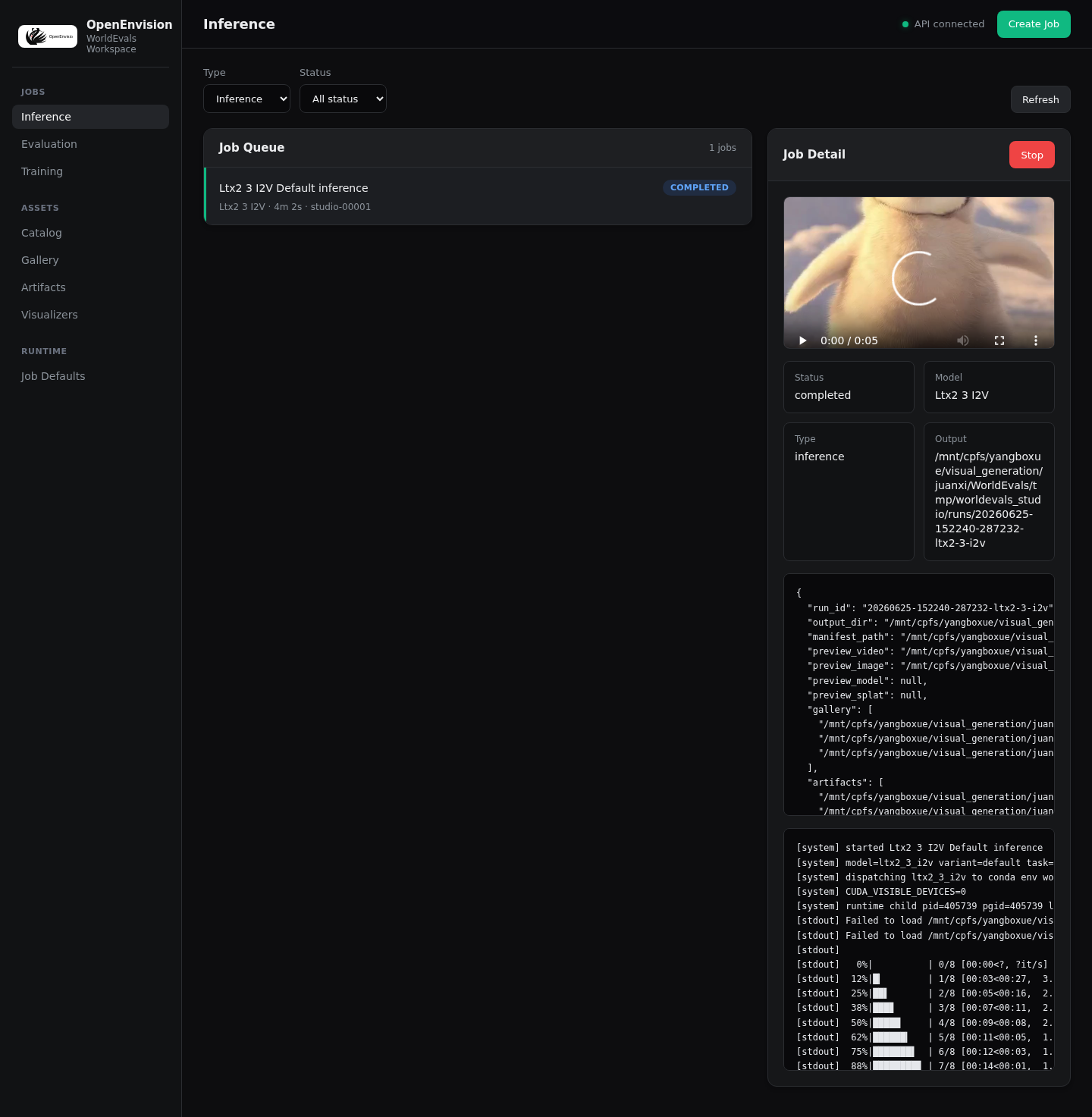
| Inference jobs | Completed runs, inline preview media, status, and logs. |
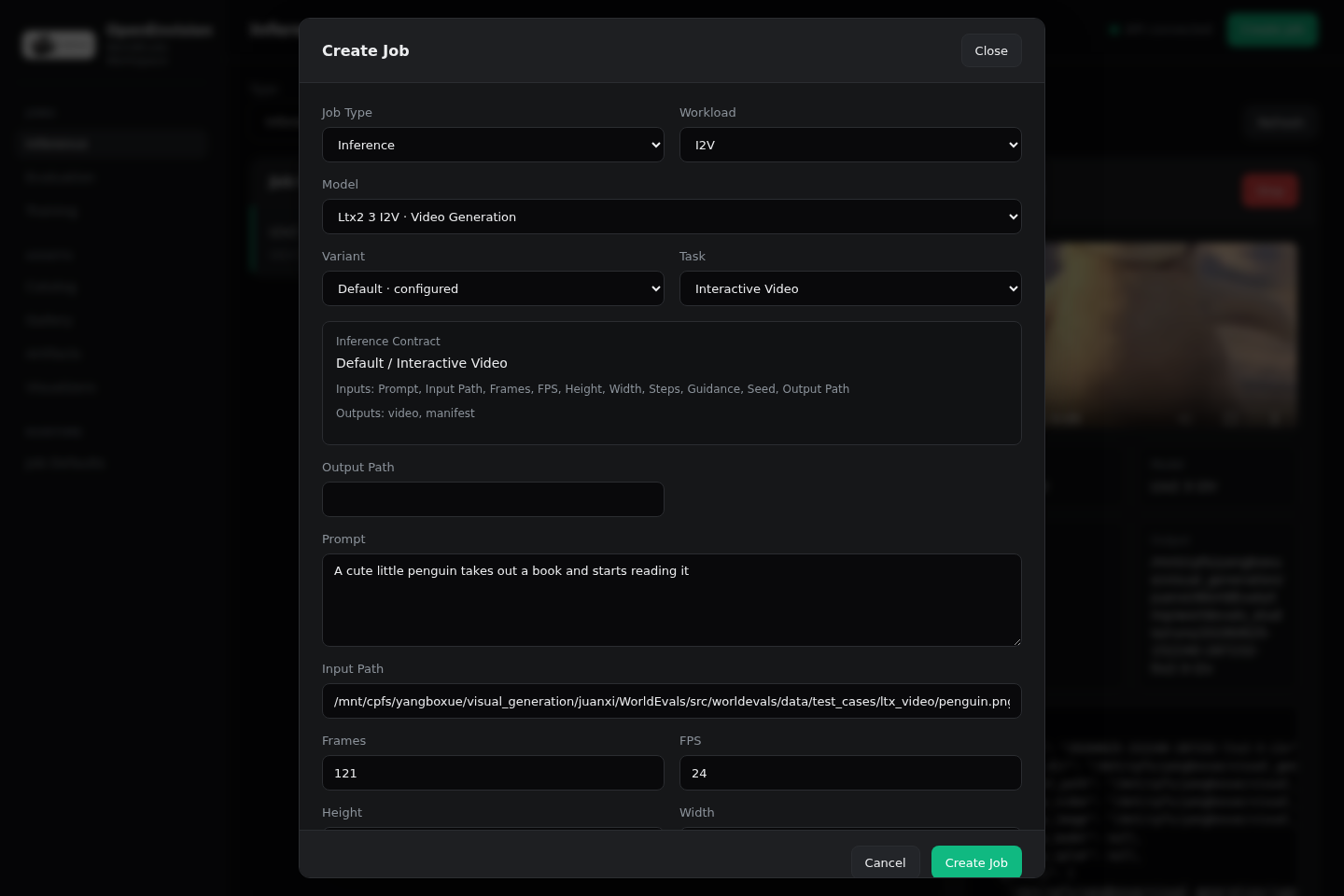
| Create Job | Model-specific inputs and official demo defaults. |
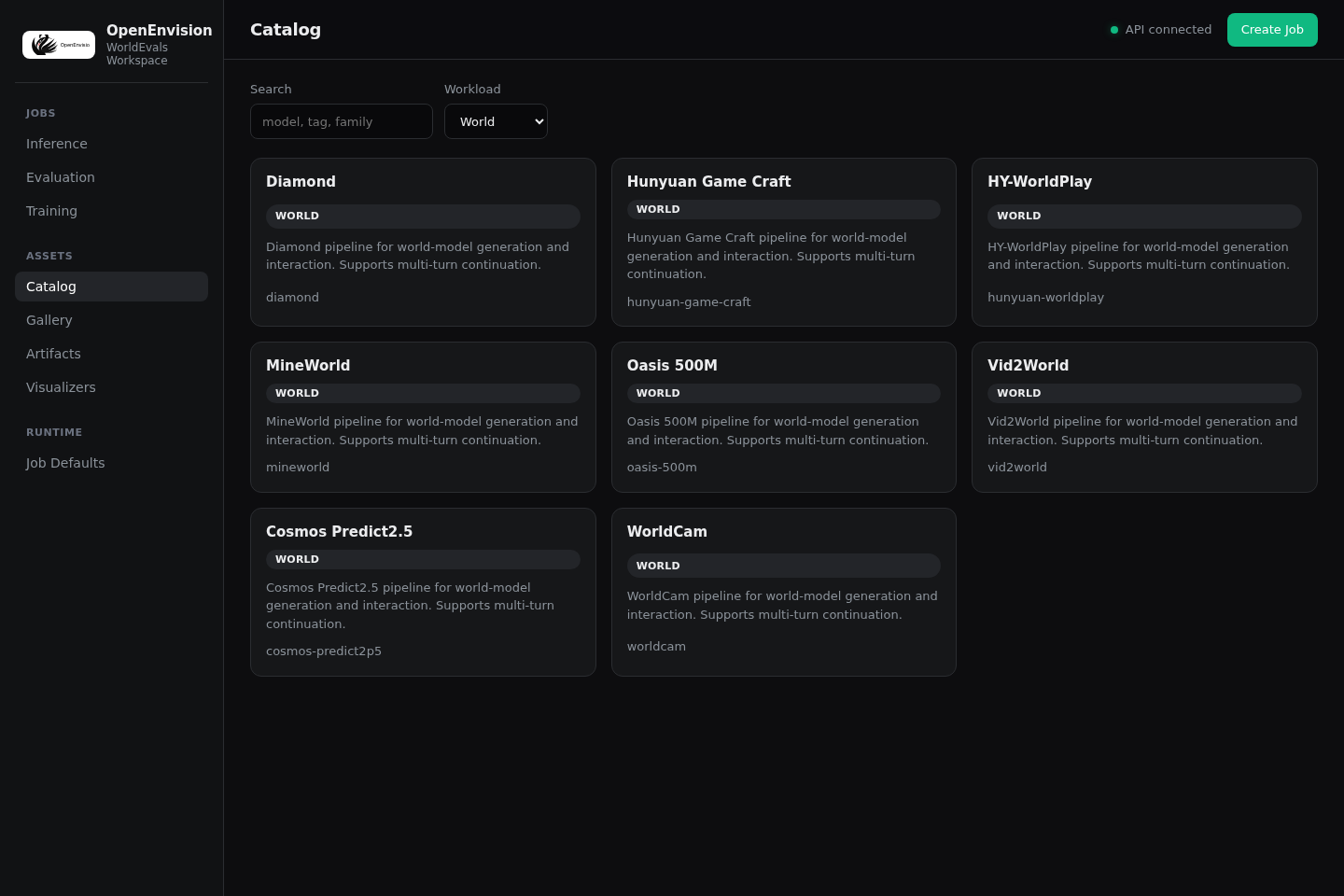
| Catalog | World-model filtering and model metadata. |
| Gallery | Recent visual outputs for side-by-side QA. |
Inference Jobs
The queue shows submitted runs, final status, and inline preview video or image when the run record exposes them.
Create Job
The form should expose the model's actual input contract. The screenshot below is only a UI-shape example; release demo claims should be checked against the validation reference and the matching run manifest.
Catalog
Catalog filtering is useful for checking which world-model entries are visible to the workspace before submitting jobs.
Gallery
The Gallery gives a compact visual pass over recent inference outputs and preview artifacts.
Inference Demo Results
The gallery below is for visual orientation. It shows representative artifacts from in-tree Studio or Studio-compatible API runs. It is not a release-claim table; exact parameters, environment notes, run ids, and remaining gaps live in the validation reference. Only curated nontrivial examples are embedded here.
Reference-to-video
Image/control-to-video
Text-to-video
Image-to-video
Text-to-video
Image-to-video
Image-to-video
Human animation
Interactive world model
Cityscape world model
Image-pose world video
Interactive village world
Camera-path world video
World navigation
Robot video-input world model
Conditioned world video
Text-to-video
Launch matrix
| Use case | Command shape | Notes |
|---|---|---|
| LingBot realtime | python -m worldfoundry.studio.app lingbot-world --variant fast --frontend world --device cuda:1 | Resident runtime with continuous WebRTC video and DataChannel controls. |
| LingBot camera | python -m worldfoundry.studio.app lingbot-world --variant base-camera --device cuda:1 | Slower, camera-centric profile. |
| MatrixGame | python -m worldfoundry.studio.app matrix-game-2 --device cuda:1 | Interactive world navigation. |
| WorldCam | python -m worldfoundry.studio.app worldcam --device cuda:1 | Camera-path generation and view control. |
| Hosted APIs | python -m worldfoundry.studio.app <model> --backend api_init --endpoint <url> | Endpoint stays explicit at launch. |
| Viser point cloud | python -m worldfoundry.studio.app pi3 --frontend points --asset /path/to/scene.ply --port 18590 | Native Viser UI. |
| Spark 3DGS | python -m worldfoundry.studio.app vggt --frontend spark --asset /path/to/scene.splat --port 8765 | Standalone Spark canvas. |
| Embodied simulator | python -m worldfoundry.studio.app openvla --frontend embodied --simulator-url http://127.0.0.1:9000 | Planned. Registers an external simulator URL only; does not launch an in-tree viewer. |
Recommended local start:
cd /path/to/WorldFoundry
PYTHONPATH=. WORLDFOUNDRY_STUDIO_PORT=7868 conda run -p "${WORLDFOUNDRY_UNIFIED_ENV_PREFIX}" python -m worldfoundry.studio.app \
  lingbot-world \
  --variant fast \
  --model-ref /path/to/checkpoints/lingbot-world-fast \
  --device cuda:1
For an editable checkout that is not installed into the active environment, keep
PYTHONPATH=. in the command.
Studio prints the resolved workspace, model, cache, and Hugging Face cache roots at startup, so path issues are visible before a run begins.
Open:
http://127.0.0.1:7868For remote GPU nodes, use the SSH tunnel printed by Studio.
The world process serves the page and WebRTC signaling on the configured HTTP
port. Video and controls then use the ICE-selected WebRTC path. A plain SSH
forward only carries signaling; for a browser that cannot directly reach the
GPU host, configure a TURN relay with
WORLDFOUNDRY_REALTIME_ICE_SERVERS_JSON.
ssh -N -L 7868:127.0.0.1:7868 user@gpu-host
# local browser:
# http://127.0.0.1:7868
The status strip reports RTC playback FPS, generation time, control latency, queue depth, and dropped stale frames. An ICE timeout is surfaced explicitly instead of leaving the page indefinitely in a connecting state.
Interaction modes
| Mode | Flow | Best for |
|---|---|---|
| Image World | Select a tray image or upload an image -> START -> hold keyboard or stick controls | Image-conditioned interactive world models. |
| Video World | Upload a video -> START -> continue with video-to-video world-model flows | Video-conditioned world models. |
| Stream | Seed input -> start one persistent session -> send key edges while frames continue | Interactive world models and continuation. |
| Prompt-scheduled segments | Enter a prompt, optionally select an image, then START; edit the prompt and press Enter after the current segment | Models that accept a new prompt at native segment boundaries. |
| Queued controlled segments | Select an initial image, dense control video, sparse control video, and prompt -> RUN; select new controls before each EXTEND | Long-form models with explicit per-segment control inputs. |
| Spatial preview | Run or export 3D asset -> open 3D World | Gaussian splat, point cloud, or scene outputs. |
Keyboard/live controls:
WASD = move
Arrow keys / IJKL = look
Keyboard and stick edges are sent immediately over the current realtime channel. The resident runtime samples the latest effective control state at model chunk boundaries, so input does not create a second inference request or reload the pipeline.
Live text events, idle steps, and output resolution
The world frontend exposes three ordered controls beside the keyboard and
joysticks:
- Text events: open INITIAL SCENE, choose ADD, and enter an event ID, button label, and prompt. APPLY installs the catalog before a session or replaces it while the session is live. Event buttons activate one text condition at the next model chunk boundary; CLEAR EVENT restores the base prompt. Models without a state-preserving text-update path disable this surface instead of acknowledging an update they cannot apply.
- STEP: queues exactly one generated chunk with no keyboard direction. It is useful for an idle camera or for checking a text event. It does not enable an autonomous generation loop. Queued-segment models keep STEP disabled because their next segment requires new control videos.
- OUTPUT: selects the transmitted frame size. NATIVE preserves the model output size. Smaller choices resize and letterbox only the WebRTC/WebSocket stream; they do not change model inference resolution, sampling steps, causal state, or future world quality.
Event IDs contain 1-64 letters, numbers, or _.:-; labels are at most 64
characters, prompts are at most 1,000 characters, and a catalog contains at most
12 events. Catalog updates carry a revision so a stale editor cannot silently
overwrite a newer live catalog.
The reliable control channel returns event_catalog_ack, event_ack,
step_ack, and output_config_ack. An event or output ACK means the ordered
request was accepted and reports where it takes effect (next_chunk or
next_segment); chunk_done remains the completion signal for generated
output. Resolution changes are frozen at a complete transport-chunk boundary,
so an already announced chunk is never truncated or mixed across dimensions.
Each request and ACK carries the same request_id, so rapid clicks cannot let
an older response overwrite the current UI state.
The same protocol can be driven without the built-in controls:
{"type":"event_catalog","request_id":"catalog-1","base_revision":0,"events":[{"event_id":"rain","label":"Rain","prompt":"Heavy rain begins.","category":"weather"}]}
{"type":"event","request_id":"event-1","event_id":"rain","state":"trigger"}
{"type":"event","request_id":"event-2","state":"clear"}
{"type":"action","request_id":"step-1","action":{"event":"step"}}
{"type":"output_config","request_id":"output-1","resolution":{"mode":"fixed","width":640,"height":360}}
Fixed transport dimensions must be even, at least 160x90, no larger than the
model's native/generated frame on either axis, and within the realtime
1920x1080 pixel budget. Studio advertises only source-safe presets derived
from the model catalog; if the native size is unknown, it does not guess a
fixed preset. Switching back to {"mode":"native"} removes the transport
scaler. WebRTC resize work runs before frames enter the media track, so held
frames do not repeatedly pay the resize cost or block the control event loop.
Draggable and collapsible panels
STATUS, CONTROLS, INITIAL SCENE, and RUNTIME share the same panel
behavior. Drag a panel header to float it above the viewport, click − to
collapse it, and click + to reopen it. The browser clamps floating panels to
the visible stage, raises the selected panel, and saves positions and collapsed
state locally. Dragging uses one animation-frame transform per browser frame and
does not add work to the model/frame transport path. On narrow mobile layouts,
panels stay in document flow but remain collapsible.
Immersive fullscreen and live runtime log
The fullscreen view is part of the shared world frontend and is available to
every interactive model routed to that frontend. It reuses the current peer or
socket, frame buffer, and resident model session. Entering or leaving fullscreen
does not reconnect the browser or restart generation.
- Prepare the model input and start the session normally.
- Click FULLSCREEN in the upper-left corner of the viewport, or press
F. - The viewport fills the screen and the live runtime log opens automatically.
- Click LIVE LOG or press
Shift+Lto hide or show the log without leaving fullscreen. - Press
Escor click EXIT to return to the standard Studio layout.
| Control | Result |
|---|---|
FULLSCREEN / F | Enter or leave immersive fullscreen. |
LIVE LOG / Shift+L | Toggle the runtime log in either the normal or fullscreen layout. L alone remains the camera-right control. |
| CLEAR | Clear the visible log history only; the model session and runtime state are unchanged. |
Esc | Leave fullscreen and return to the same active session. |
The log includes client and model readiness, realtime transport state, segment
queue/generation/playback transitions, errors, and per-chunk performance data.
A completed chunk reports its frame count, generation time (gen), playback
queue depth (queue), and discarded stale frames (dropped). These entries are
session telemetry for interactive debugging; they are not persisted run
artifacts or a copy of the server's complete stdout/stderr stream.
Live log events use the existing realtime connection. The browser batches DOM updates on animation frames and retains at most the latest 120 entries, so a long session does not accumulate an unbounded log tree or add a polling loop to the frame path. When the browser permits the Fullscreen API, the button or keyboard shortcut enters native fullscreen. If native fullscreen is unavailable or blocked by browser policy, Studio keeps the same session and falls back to a viewport-filling layout. The Workspace visualizer iframe already grants fullscreen permission.
Launch flags
| Flag | Meaning |
|---|---|
positional model_id / --model | Launch target. |
--variant | Runtime profile such as fast or base-camera. |
--model-ref / --ckpt / --checkpoint | Explicit local or repo reference. |
--device | Runtime device. |
--backend | auto, from_pretrained, or api_init. |
--endpoint | Explicit API endpoint. |
--show-aux-panels | Expose history, notes, catalog, and side panels. |
--frontend | auto, world, points, embodied, or spark. |
--asset | Remote asset path for native viewers, such as point cloud .ply/.npz or 3DGS .splat/.spz/.ply. |
--simulator-url | Native embodied simulator URL. |
--host / --port | Override frontend bind host and port. |
Environment
| Variable | Effect |
|---|---|
WORLDFOUNDRY_WORKSPACE_PORT | Workspace HTTP port (default 7870). |
WORLDFOUNDRY_WORKSPACE_MAX_JOBS | Concurrent job worker limit. |
WORLDFOUNDRY_STUDIO_SETTINGS_FILE | Optional JSON file loaded into /api/settings for Create Job defaults. |
WORLDFOUNDRY_STUDIO_PORT | Single-model Studio server port. |
WORLDFOUNDRY_STUDIO_MODEL | Default model id. |
WORLDFOUNDRY_STUDIO_VARIANT | Default variant. |
WORLDFOUNDRY_STUDIO_BACKEND | Default backend. |
WORLDFOUNDRY_STUDIO_DEVICE | Default device. |
WORLDFOUNDRY_STUDIO_ENDPOINT | API endpoint. |
WORLDFOUNDRY_STUDIO_FIXED_MODEL_REF | Fixed local model/checkpoint ref. |
WORLDFOUNDRY_STUDIO_SHOW_AUX_PANELS | Show advanced panels. |
WORLDFOUNDRY_STUDIO_FRONTEND | Default frontend route. |
WORLDFOUNDRY_STUDIO_ASSET | Default native viewer asset. |
WORLDFOUNDRY_STUDIO_SIMULATOR_URL | Embodied simulator URL. |
WORLDFOUNDRY_STUDIO_SPARK_PORT / WORLDFOUNDRY_STUDIO_POINTS_PORT | Per-frontend default ports. |
WORLDFOUNDRY_STUDIO_SSH_HOST | SSH host shown in tunnel hints; set it to the user's own GPU node, for example user@gpu-host. |
WORLDFOUNDRY_STUDIO_WORKSPACE_DIR | Studio run/output root; falls back to ${WORLDFOUNDRY_ARTIFACT_DIR}/studio when set, otherwise tmp/worldfoundry_studio. |
WORLDFOUNDRY_STUDIO_MODEL_ROOT | Extra local model repository root searched before shared roots. |
WORLDFOUNDRY_MODEL_DIR | Shared model/checkpoint root; Studio searches it for local repos and checkpoints. |
WORLDFOUNDRY_CACHE_DIR | Shared cache root; Studio searches ${WORLDFOUNDRY_CACHE_DIR}/hfd and ${WORLDFOUNDRY_CACHE_DIR}/repos. |
WORLDFOUNDRY_HF_CACHE_DIR | Optional Hugging Face Hub cache override. Leave unset to use Hugging Face's native from_pretrained / snapshot_download cache and auto-download behavior. |
Only WORLDFOUNDRY_* Studio environment variables are supported.
Release Evidence
Only add public demo media after the matching official configuration has run through the in-tree Studio or Studio-compatible API path. Keep the run manifest, decoded media metadata, and visual QA record with the validation artifacts so the embedded video can be traced back to an actual release candidate run.