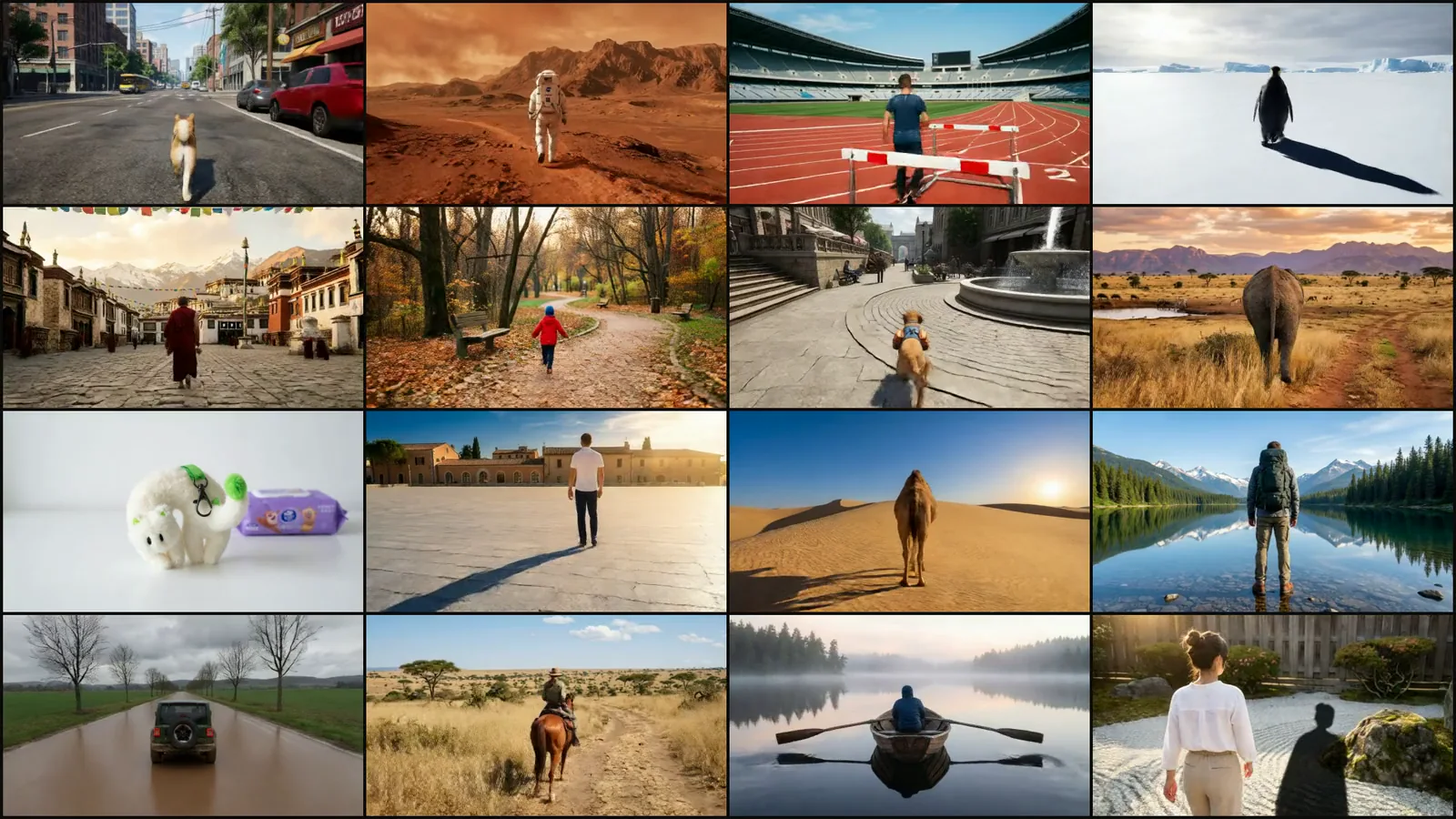

Shared
Environment setup, checkpoints, input shaping, previews, and reporting stay shared while model-specific behavior stays explicit.
Run, inspect, and evaluate world models in one reproducible workflow.
267 manifest-backed model recipesChoose a real catalog entry. Runtime and version facts come from the repository manifests, and the command stays copyable.
worldfoundry-eval evaluate \
  --mode model \
  --model-id hunyuanvideo-1.5 \
  --model-runner worldfoundry:pipeline \
  --requests-path tmp/requests.jsonl \
  --output-dir tmp/model_eval/hunyuanvideo-1.5 \
  --metric artifact_count \
--jsonInfrastructure for operating world models.
Environment setup, checkpoints, input shaping, previews, and reporting stay shared while model-specific behavior stays explicit.
Expensive outputs survive the process that created them, so they can be inspected, rescored, compared, or audited without rerunning inference.
Catalog coverage, runnable integration, official validation, and leaderboard eligibility stay separate—not collapsed into one ambiguous “supported” label.
One engine, endless possibilities. Browse integrated models and benchmarks.
225 models64 benchmarks
Video
Catalog, runtime, workspace, and evaluation share identities and durable contracts.
Manifests expose stable IDs, sources, capabilities, assets, runtime bindings, readiness, and blockers before compute is allocated.
See what is includedPipelines preserve model-native I/O while TUI, CLI, Studio, Python, and MCP reuse the same execution contracts.
Understand the designVideos, geometry, actions, trajectories, and traces stay visible on disk and in Studio instead of disappearing inside scripts.
Explore StudioBenchmark runners preserve per-sample outcomes, coverage, provenance, blockers, reports, and scorecards.
Read about evaluationFive-stage pipeline
Every surface follows the same sequence. The artifact is the handoff between model execution and benchmark evaluation.
Discover
Catalog manifests expose stable IDs, capabilities, readiness, assets, and blockers.
Prepare
Resolve the conda profile, checkpoints, datasets, metric weights, and credentials.
Run
TUI, CLI, scripts, and Studio dispatch to a pipeline and operator.
Inspect
Videos, geometry, actions, traces, and metadata remain visible and reusable.
Evaluate
Metrics and official runners write reports, blockers, and a normalized scorecard.
Everyone welcome
Whether you're just getting started or debugging a complex run, the community is open to everyone. No question is too basic.
Notes, events, and lab context around the project.
Sibling projects and source links in the OpenEnvision ecosystem.